
Find Saratoga Springs Residents From a Starting Point
No public source is a master list of every Saratoga Springs household. A property question starts with a street number or parcel. A one-person question starts with a full name plus a stable detail, such as an address, year, court index number, business name, or license number. An older address needs a deed reference, directory year, map, census, or newspaper trail. Those paths answer different questions, and each belongs to a different custodian.
Use the smallest record set that answers the question. County property and map tools can identify a parcel. A recorded deed can confirm a transaction but not daily occupancy. Printed directories and census schedules supply past-household context. A missing match can reflect spelling, format, jurisdiction, or restriction, so it is not proof that no record exists.
- Search the county property system by a current address or owner name and record the parcel identifier.
- Use the county map to confirm the location, municipality, and adjacent parcels.
- Follow a deed reference through the County Clerk land index when ownership history matters.
- Compare several directory years with census and newspaper material for a past household.
- Ask the relevant clerk, library, historian, or records officer when an online result is incomplete.
Saratoga Springs Resident Records Offices
Saratoga Springs is in Saratoga County, but the county seat and several key counters are in Ballston Spa. The City Assessor is the city office for assessment records. Countywide PROS and the map viewer make parcel information available online. The County Clerk keeps land records and many court files. The Board of Elections administers registration records under state rules. Together, they show why a resident search often crosses city, county, and state lines.
Saratoga Springs City Assessor
474 Broadway, Suite 14
Saratoga Springs, NY 12866
518-587-3550 ext. 2551
Saratoga County Board of Elections
50 West High Street
Ballston Spa, NY 12020
518-884-8350
County Clerk research hours are 9 a.m. to 5 p.m.; land recordings and court filings end at 4:15 p.m. Its land and court holdings date to 1791. The City Assessor retains Saratoga Springs assessment records, while county historical assessment holdings have their own boundaries and time frames. Note: A city, county, or state mailing label does not make records from those offices interchangeable.
Search Saratoga Springs Parcels in PROS
Saratoga County PROS accepts Street Address, Tax Map number or SBL, Owner Name, Street Finder, and Municipality. An SBL is a section-block-lot identifier. It gives a bridge from a street address to an assessment card, map layer, and recorded deed reference. An assessment card can show location, class, owner, owner mailing address, assessment, exemptions, parcel size, and a deed book/page.
| PROS field | Input | Use |
|---|---|---|
| Street Address | Number and street | Find a parcel at a physical location. |
| Tax Map / SBL | Tax-map number | Use a stable parcel identifier. |
| Owner Name | Last, First; = exact prefix | Narrow a common surname. |
| Street Finder | Public-road selection | Browse addresses on a selected road. |
| Municipality | County municipality | Separate a city parcel from another county location. |
Mailing address is a tax-contact field and can be a post-office box or another place. It is not a residence claim. The county changed its assessment platform from SDG Image Mate Online to GAR Pros in September 2025, so older bookmarks can point to a different vendor.
See the current PROS search form before entering a query.
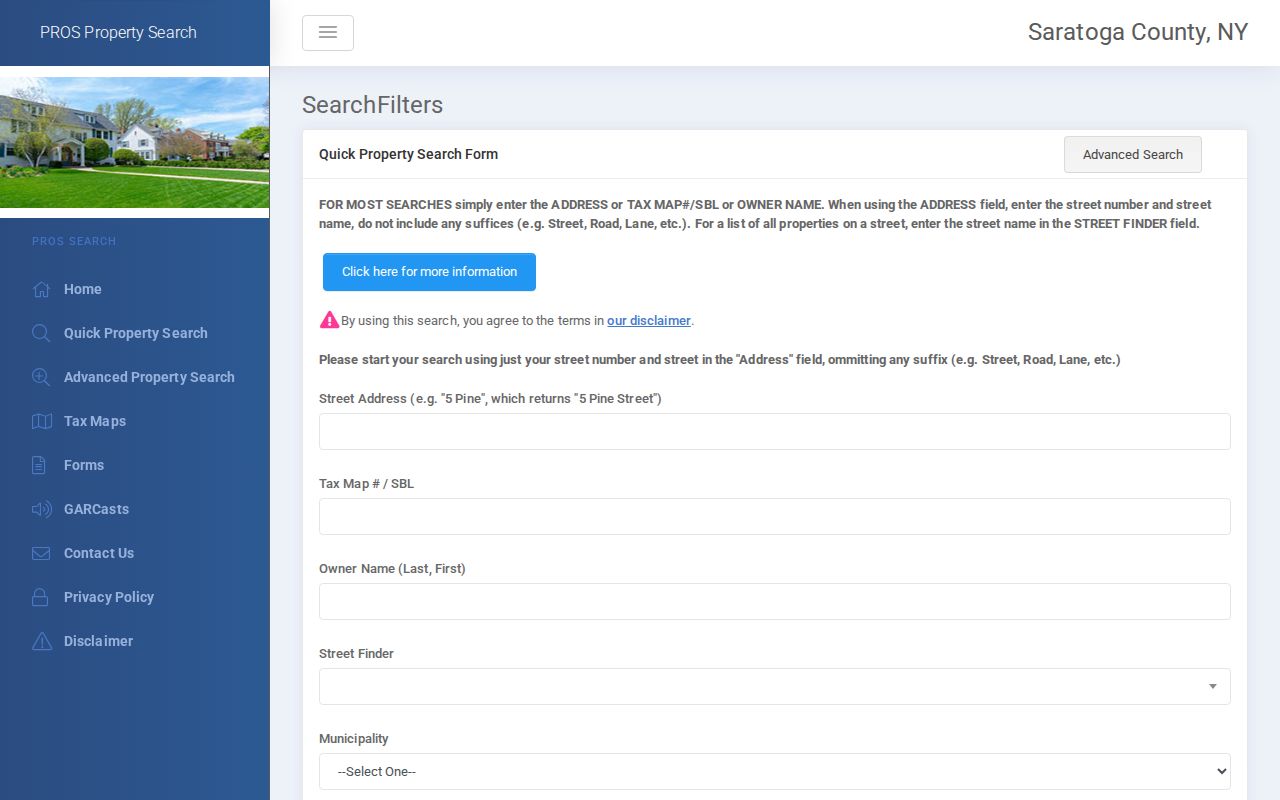
The form shows why address, SBL, and owner name should be retained as separate keys.
Map Saratoga Springs Parcels Across Annual Layers
The Saratoga County Map Viewer adds geography that an assessment card cannot show. Its parcel search accepts owner name, address, parcel ID, and partial strings. The viewer includes Map Panel search, Parcel Search, Data Query, Map Selection, layer controls, print, and export tools. Parcel and aerial layers may appear only after zooming to an appropriate scale.
The ArcGIS service has annual parcel layers from 2010 through 2026 plus city, town, village, school, fire, election-district, poll-site, street, and planning layers. Use a dated layer to understand geometry in that assessment year. It is not title evidence, and county tax maps are assessment tools rather than land surveys.
Open the county GIS viewer to inspect a parcel’s map context.
The map makes it easier to confirm a street, boundary, and adjacent parcel before reading a record card.
Current Saratoga Springs Resident Directory Sources
Current sources are partial by design. They describe an owner, registered voter, party to a recording, license holder, or business entity rather than every person at an address. Reading their scope prevents one record from carrying more weight than it can support.
| Record source | What it confirms | Custodian | Access route |
|---|---|---|---|
| PROS assessment data | Parcel, owner, mailing field, assessment, deed reference | Saratoga County | Online and assessor office |
| Voter status lookup | Status for matching individual query | NYS Board of Elections | Online individual lookup |
| Recorded land index | Named recording parties | County Clerk | SearchIQS, public computers, counter |
| Professional verification | License identity and status | NYSED | Online search |
| Business inquiry | Entity and filing details | NY Department of State | Online inquiry |
The strongest answer joins two independent fields, not two pages that repeat an unverified name. For one-person questions, the Saratoga Springs resident lookup keeps court, vital, and license checks in context. An ownership interest is not proof of present-day occupancy.
Trace Saratoga Springs Deed Parties to 1791
The County Clerk registers deeds, mortgages, satisfactions, judgments, liens, powers of attorney, and related records. Its land and court holdings date to 1791. The online path is SearchIQS; account creation and image access may have terms not visible until a user enters the service. Public computers and in-person research remain important fallbacks.
Start with the owner or deed reference from PROS, then compare grantor, grantee, recording date, book/page, legal description, and prior-instrument reference. A grantor transfers an interest and a grantee receives it. The chain can reach an earlier owner when a street number changes. It does not establish every occupant who used the property.
- Parcel
- A mapped unit of land used for assessment and tax administration.
- Situs address
- The physical property location, which can differ from an owner’s mailing address.
- Index
- A search aid that points to records and may not be the full image.
- Criss-cross directory
- An address-oriented format whose local coverage must be confirmed at the shelf.
Check Saratoga Springs Voter Status Carefully
New York’s voter registration search is an individual status tool, not a Saratoga Springs roster. Its visible fields include county, last name, first name, date of birth, ZIP Code, and address information. A match is useful only when the required identifiers point to the person being checked. A no-match can reflect spelling, format, wrong county, inactive status, or confidential registration.
Election Law §3-220 permits supervised inspection while excluding driver-license, non-driver ID, Social Security, and facsimile information. Election Law §3-103 limits statewide list use to election purposes. Historical voter lists from 1912 through 1975 are a separate County Historian inspection resource.
Review the official voter lookup before entering data.
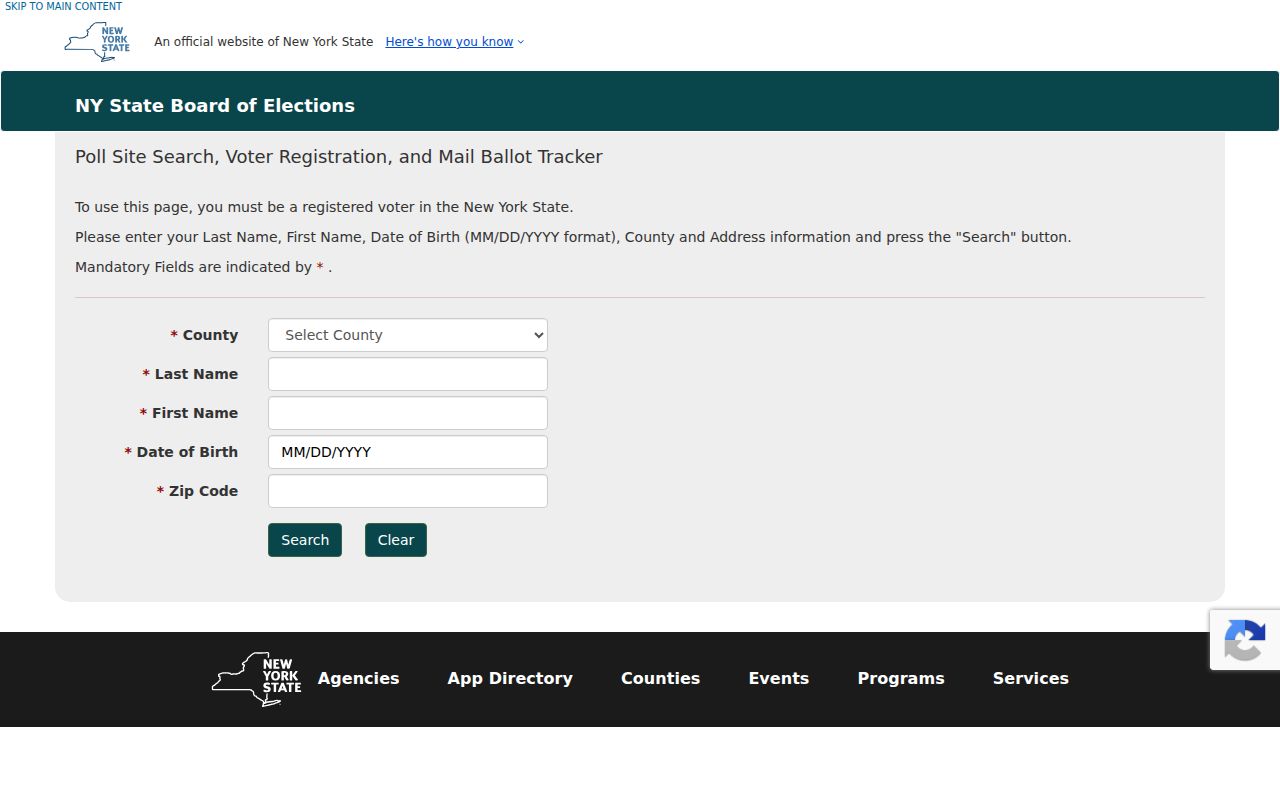
The required county, name, and birth-date fields show why a broad name search is not its purpose.
Choose the Right Saratoga Springs Court
A court name search needs the right court level. Supreme and County Court are at 30 McMaster Street, Building 3, in Ballston Spa; Saratoga Springs City Court is at 474 Broadway. Surrogate’s Court has probate and estate records. The NYSCEF guest case search supports case-identifier, name, Tax Cert/SCAR, and new-case modes, but public e-filed material is not a complete history of every local proceeding.
Use case number, year, court, county, case type, and party role to separate same-name results. Older material may require the clerk or County Clerk. Sealed divorces, adoptions, guardianships, and protected Family Court material are not an open name-search pool. A court result is a case record, not a conclusion about a person.
See the NYSCEF search options before selecting a mode.
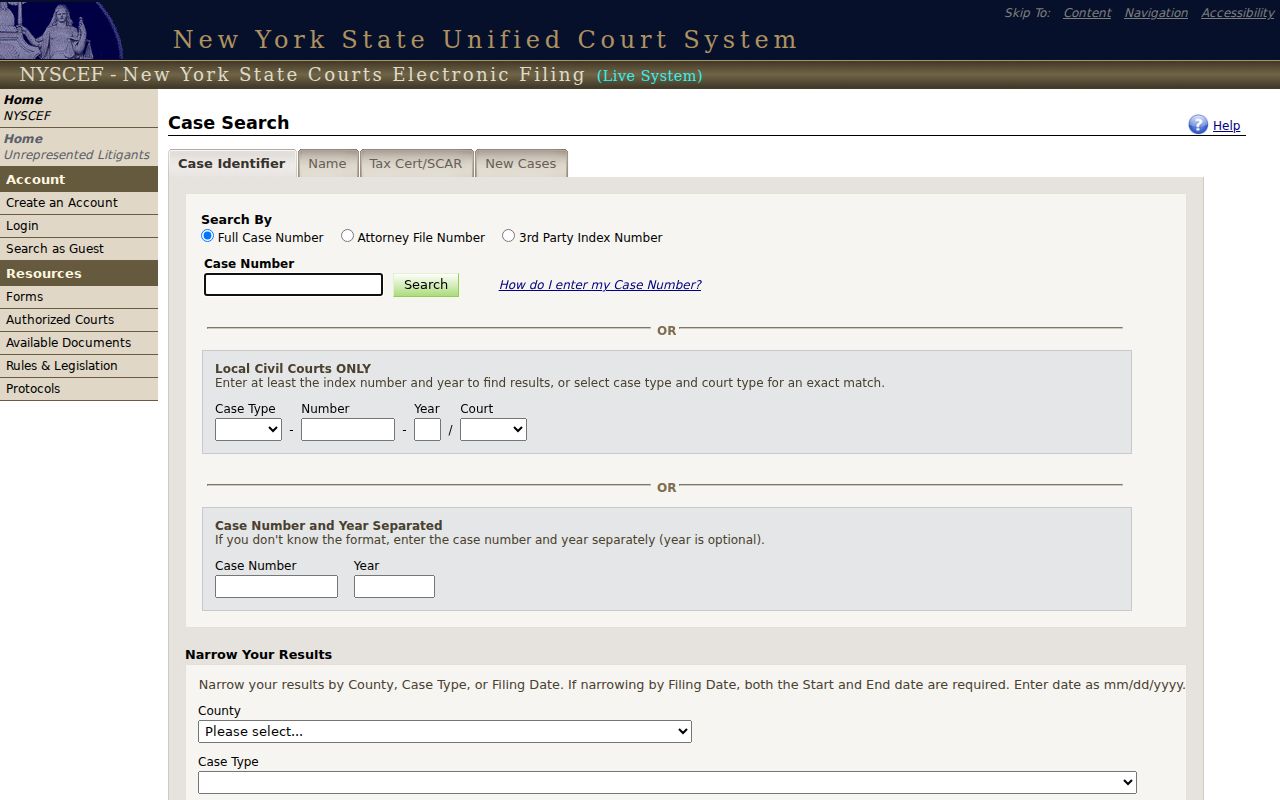
The search modes narrow a question by identifier, name, court, or filing date.
Order Saratoga Springs Vital Records Correctly
Vital records have event-place and eligibility rules. The Saratoga Springs City Clerk Vital Records office handles city events and city-issued marriage licenses through its form and mail route; certified copies are listed at $10 each. A Saratoga Springs mailing address does not prove an event happened in the city. For another municipality or an unknown place, use that registrar or the New York State Department of Health.
State birth, death, marriage, divorce, and adoption routes have separate rules. Genealogy access opens after 75 years for births when the person is known dead, 50 years for deaths, and 50 years plus both spouses’ deaths for marriages. Certified and genealogy copies are different products. FOIL does not override vital-record confidentiality.
Use the City Clerk vital-records page for local forms and jurisdiction details.
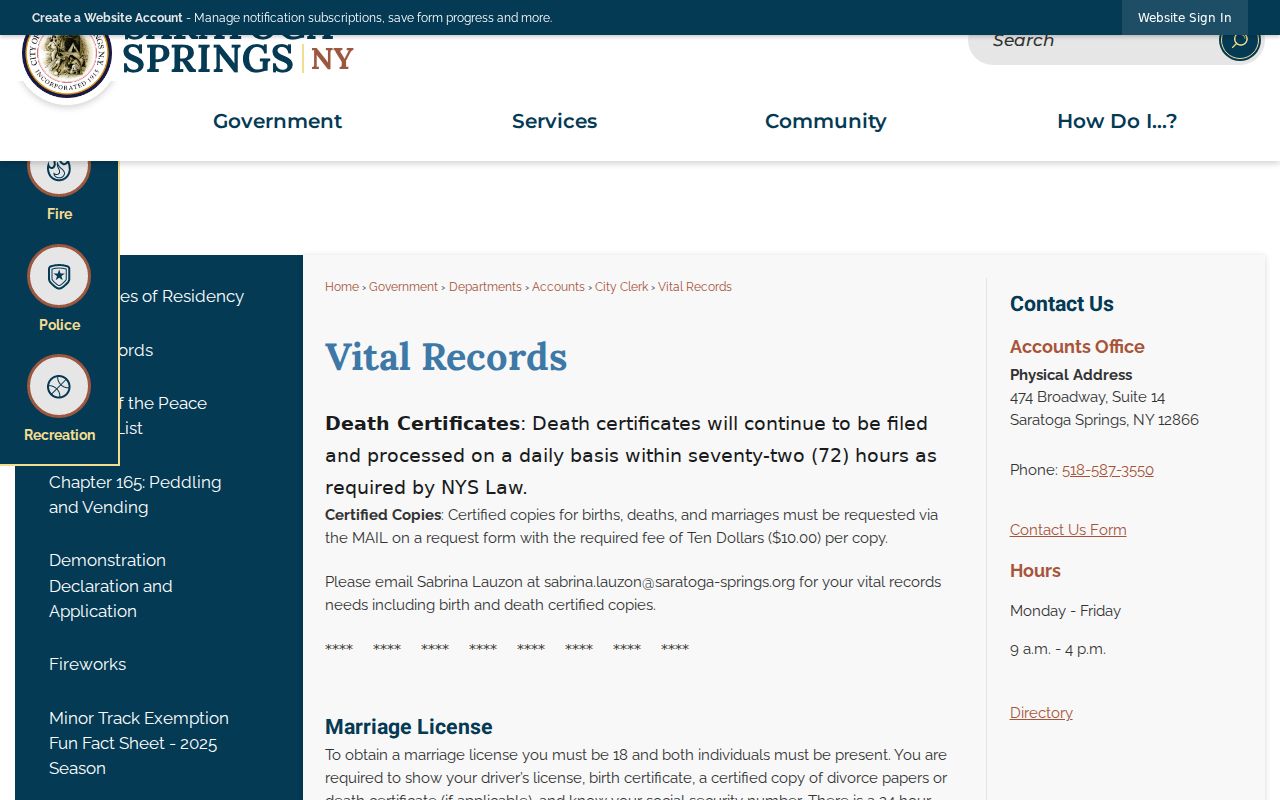
The city page distinguishes local event jurisdiction from a general name lookup.
Historical Saratoga Springs Resident Directories
The New York State Library lists Saratoga Springs city directories for 1872 through 1944 and 1946 on non-circulating microfilm in its 7th-floor Microforms Area. It also lists local telephone books for 1922; 1940 through 1942; 1945 through 1947; and 1949 through 1950. A directory can preserve an address, initials, business line, or subscriber trail, but it is not a census or proof of ownership.
Check several years and read the edition’s conventions. The official table did not establish a publisher for every local run or supply an inspected entry image, so a uniform format should not be assumed. The Saratoga Springs Directory Book gives collection and tracing detail.
Start with the New York State Library directory table.
The Saratoga Room local-history page identifies the collection that supports this directory trail.
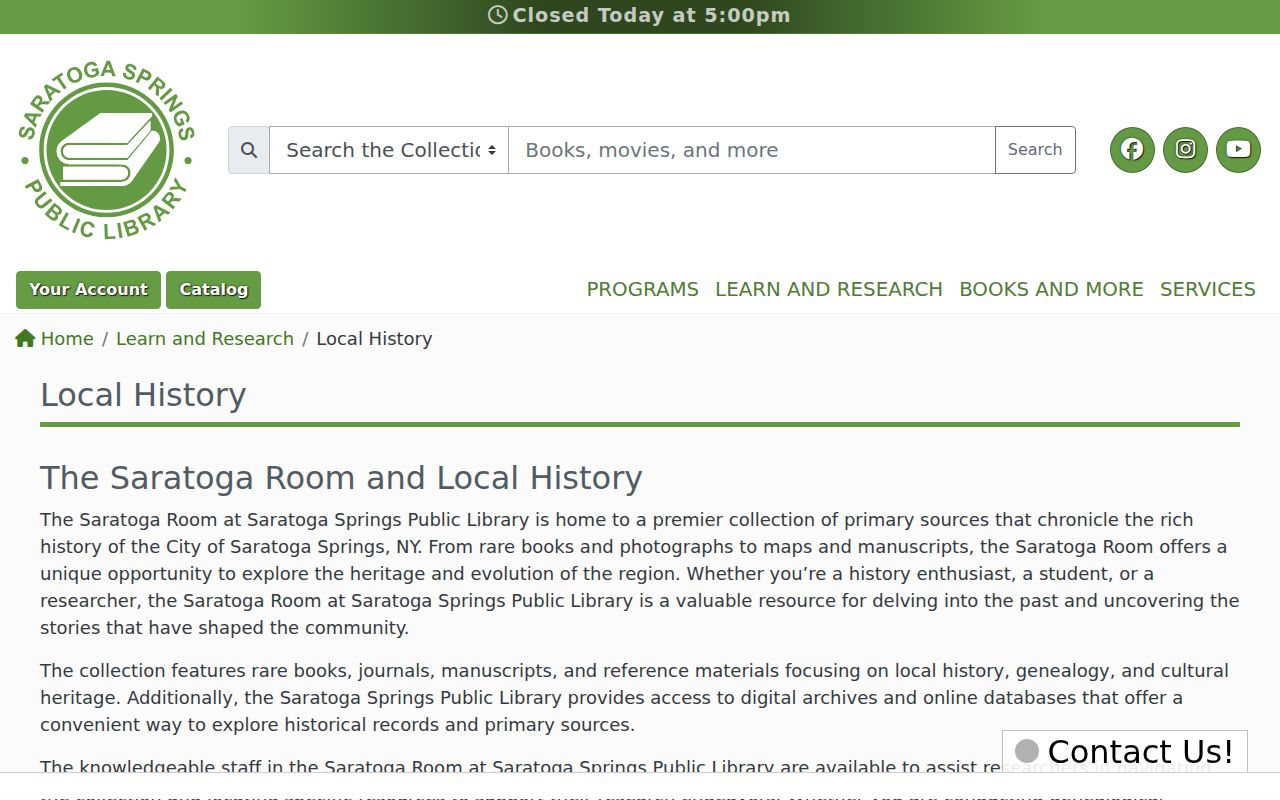
The Saratoga Room adds newspapers, maps, manuscripts, digital exhibits, and staff help.
Saratoga Springs Historians Keep Narrow Name Trails
The City Historian holds town, village, city, Board of Education, and map groupings for inspection. The archive guide identifies village assessment and tax material from 1866 to 1915, tax-sale books, chattel mortgages, dog registers from 1911 to 1913, and the Greenridge Cemetery Book from 1843 to 1847. These series can connect an address or family name to a narrow event, but none is a full directory.
The County Historian adds census microfilm, voter lists, cemetery files, tax records, surname files, maps, photographs, and local-history collections. The Saratoga Room at 49 Henry Street provides rare books, maps, manuscripts, newspaper resources, and digital links. Inspection and staff contact are access channels when a collection has no public web search.
Explore the Saratoga Room resources before arranging an in-person visit.
The Saratoga County FOIL request page shows the written fallback for a county record that is not posted.
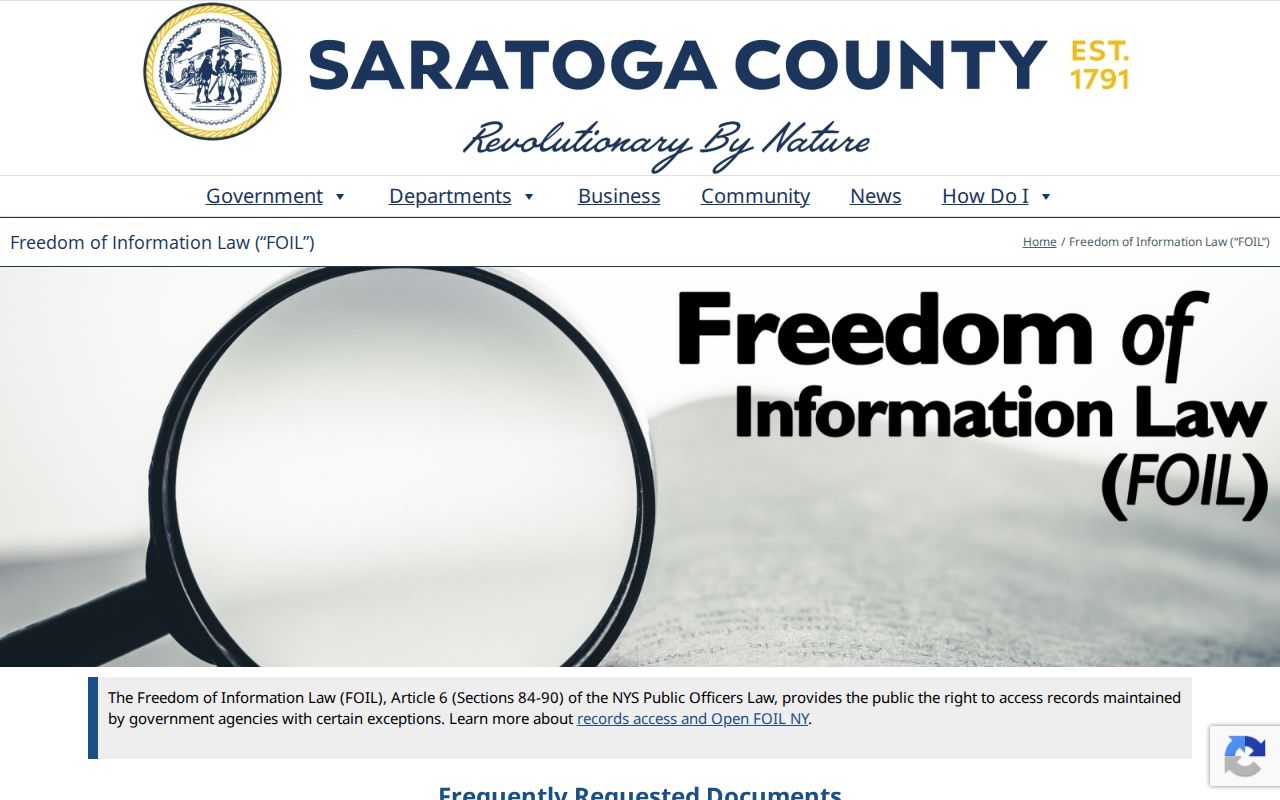
A written request is a fallback for a described county record, not a substitute for archive inspection or a restricted-record process.
Saratoga Springs FOIL Record Fallback
When an identified county record is not available through the property system, map viewer, land index, library, or historian, a written Freedom of Information Law request is the next access channel. Saratoga County accepts a written request by mail, email through its county page, or in person through the County Attorney’s Office. Describe the agency, record series, date range, and subject clearly enough for the custodian to locate it.
The county says it will provide access, deny in writing, or acknowledge the request with an estimate within five business days. Inspection is by appointment, and the standard copy charge is normally $0.25 per page. A request does not open sealed, confidential, or specifically restricted records. Appeal procedures apply when access is denied.
Saratoga Springs ZIPs Are Not City Lines
ZIP Code 12866 is Saratoga Springs’ primary postal identifier, but a postal city label is not the legal municipal boundary. The USPS ZIP Lookup can search by street address, city and state, or ZIP Code. It is the authority for an exact mailing address. County GIS and municipality layers are better tools for a city-boundary question.
PROS has no exposed ZIP field. Use an address and municipality, then compare the result to USPS and GIS rather than assuming nearby postal codes serve city parcels. That distinction matters when an older directory, tax book, or deed uses a former place label.
Protect Saratoga Springs Confidential Addresses
Public access has limits. The New York Address Confidentiality Program gives qualifying participants a substitute address, and confidential voter registration is a separate election route. DMV identity data, sealed court material, restricted vital records, and protected election fields follow their own rules. A record that cannot be found may be protected rather than absent.
When a safety exception may apply, ask the custodian about its own redaction or disclosure process. There is no single deletion form for every clerk, elections office, court, registrar, or records agency.
Saratoga Springs Records Have Documented Gaps
Saratoga Springs changed from town and village administration to city administration in 1915. Older village assessment and tax material has documented missing 1870 and 1880 records, and the archive guide identifies additional missing day-book volumes. A gap does not mean an address or person was absent. The next source may be a county deed, city directory, census, newspaper, map, or another tax series.
Maps are a strong local bridge. The City Historian describes roughly 900 historical maps spanning about 1773 to 1991, and the local trail includes 1894 and 1915 assessor-map references. Pair a map with the dated record that produced it. That preserves the difference between map location evidence and a legal survey or title record.